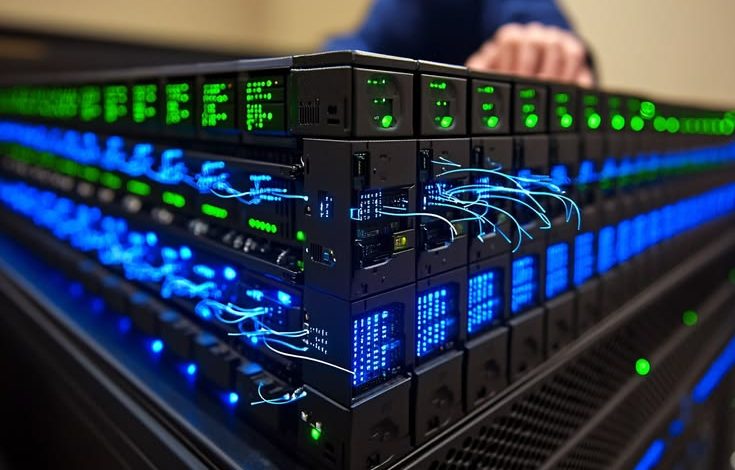
HPE Raises Its Forecasts as Demand for AI Servers and Networking Equipment Surges
The demand for artificial intelligence infrastructure is continuing to reshape the technology industry, and Hewlett Packard Enterprise is one of the latest companies to benefit.
HPE raised its forecasts after reporting strong quarterly results driven by growing demand for AI-related servers and networking equipment.
The company reported a sharp increase in revenue, while demand for infrastructure connected to artificial intelligence continued to exceed expectations.
But the results also revealed one of the biggest challenges facing the AI industry.
Demand may be growing rapidly.
Supply is struggling to keep up.
HPE said demand for key technology components remains intense as companies expand their investments in artificial intelligence infrastructure.
The Infrastructure Behind Artificial Intelligence
The public conversation around AI often focuses on software.
Chatbots.
AI assistants.
Image generators.
Automated systems.
But those products depend on an enormous amount of hardware.
AI systems require powerful servers capable of handling large amounts of computing.
Those servers need processors, memory and storage.
They also need networking systems capable of moving enormous amounts of information.
As companies build larger data centres, the demand for this infrastructure is rising rapidly.
HPE is benefiting directly from that trend.
The company raised its fiscal forecasts after strong demand pushed revenue higher, particularly across its cloud, AI and networking businesses.
Networking Is Becoming More Important
One of the most interesting parts of HPE’s growth is the role of networking.
Artificial intelligence systems do not simply depend on powerful individual processors.
Large AI workloads often involve thousands of computing components working together.
Those systems need to communicate quickly and efficiently.
That makes networking increasingly important.
A powerful server is only one part of an AI infrastructure system.
Companies also need the technology capable of connecting servers, storage and other computing resources.
HPE’s expanding networking business reflects that changing reality.
The AI race is creating demand across the entire technology infrastructure chain.
Oracle and the Expanding AI Infrastructure Market
HPE is also expanding its collaboration with Oracle to support the software company’s growing AI infrastructure.
The partnership includes the deployment of HPE’s Juniper networking technology across Oracle’s AI data centres.
The development demonstrates how closely connected the AI infrastructure market has become.
One company develops software and cloud services.
Another provides servers.
Another provides networking.
Others manufacture chips.
Together, they form the physical infrastructure behind artificial intelligence.
The AI economy is becoming increasingly dependent on partnerships between technology companies.
No single company can easily control every part of the infrastructure required.
Demand Is Outpacing Supply
HPE’s results also highlighted an important challenge.
Demand for technology components is growing quickly.
Memory, processors, storage and other hardware remain under pressure as companies compete for supplies.
That creates risks.
Companies may have customers ready to buy new AI systems but still struggle to obtain enough components to meet demand.
Supply constraints can also increase prices and delay infrastructure projects.
The AI boom is therefore producing a situation where technology companies are racing to expand their capacity while simultaneously competing for the components needed to build it.
AI Is Reshaping Traditional Technology Companies
HPE’s recent performance is another reminder that artificial intelligence is not only benefiting new startups.
Established technology companies are also finding new opportunities.
Companies that have spent decades building servers, networking equipment and enterprise infrastructure are becoming increasingly important again.
The AI industry needs the hardware they provide.
This could create a major shift in how investors view traditional technology companies.
For years, consumer internet companies and software platforms dominated much of the technology conversation.
AI is bringing attention back to infrastructure.
Servers matter.
Networking matters.
Data centres matter.
The companies building these systems are becoming increasingly important.
A Bigger Industry Than AI Software
The HPE story is also evidence that the AI boom cannot be understood by looking only at AI companies.
The industry is creating a wider ecosystem.
Chip manufacturers benefit.
Cloud providers benefit.
Server manufacturers benefit.
Networking companies benefit.
Power infrastructure companies benefit.
Cooling companies benefit.
The AI economy is gradually becoming an infrastructure economy.
And HPE’s latest results show just how quickly that infrastructure market is growing.
The company may not be building the world’s most famous AI chatbot.
But it is helping provide the technology required to keep the AI industry running.
That could prove to be one of the most valuable positions in the next phase of the technology boom.